



If you’ve spent even one summer in Fort Saskatchewan, you already know how quickly the sky can turn. A warm, still afternoon builds into towering grey clouds, the temperature drops, and within minutes hail is drumming off your deck and siding. Central Alberta sits in one of the most hail-prone corridors in the country, and every storm season leaves its mark on local roofs whether homeowners realize it or not.
That last part is the real problem. Hail damage rarely looks dramatic from the ground. Your roof can absorb a serious beating and still appear perfectly fine from the driveway, all while the protective layer that keeps water out is quietly failing. Understanding what hail actually does, how to recognize the signs, and why prompt repair matters is the best way to protect your Fort Saskatchewan home from a small storm turning into a big, expensive leak.
Why Fort Saskatchewan Sees So Much Hail
Alberta’s prairie summers are practically engineered to produce hail. Warm, moist air rises off the sun-baked ground and collides with cold air high in the atmosphere, fuelling the tall, energetic thunderstorms that roll across the region from late spring through the end of summer. When those storms mature, they can suspend ice high enough and long enough for hailstones to form, grow, and eventually fall. Fort Saskatchewan and the greater Edmonton area sit right in this storm track, which is why hail claims spike here almost every single year.
It’s a common misconception that only large hail causes damage. Golf-ball-sized stones certainly do the most obvious harm. Still, even pea- and marble-sized hail, especially when it’s driven sideways by strong prairie winds, is more than capable of bruising shingles and knocking loose the granules that keep your roof watertight. A storm doesn’t have to make the evening news to shorten your roof’s life quietly.
What Hail Actually Does to Your Roof
Hail attacks a roof on several fronts at once, and most of the harm happens to the roofing system itself rather than in ways you’d notice indoors right away.
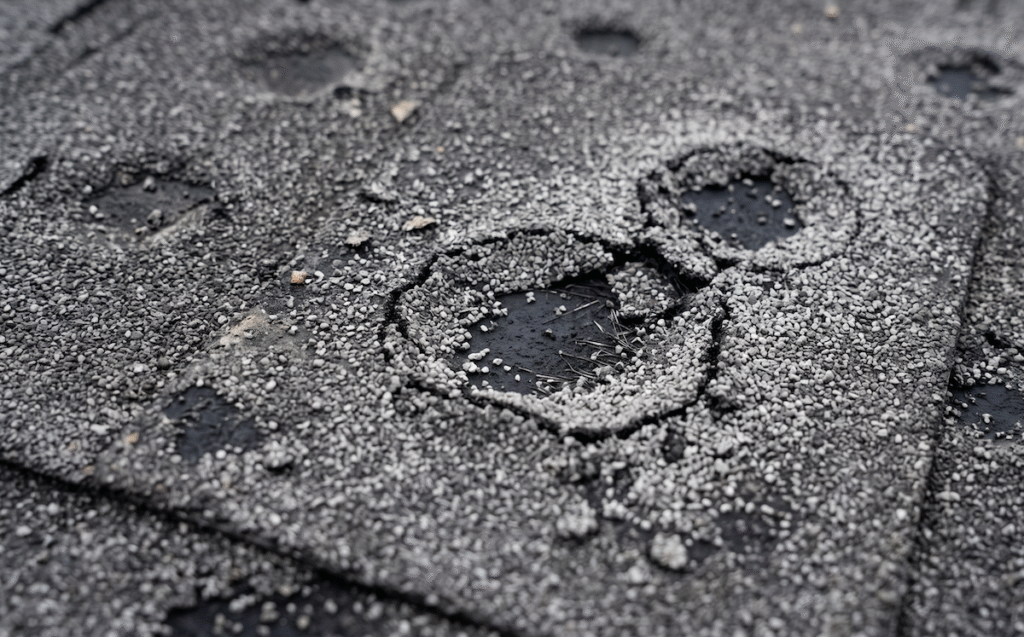
The most common damage is granule loss. Asphalt shingles are topped with a layer of mineral granules that shield the asphalt underneath from the sun’s UV rays. When hail strikes, it dislodges these granules, exposing the vulnerable material beneath and dramatically accelerating how fast that shingle ages. Alongside granule loss, hail creates bruising and cracking, soft, dented spots and hairline fractures in the shingle mat that may not leak today but very likely will once Alberta’s freeze-thaw winter works into them.
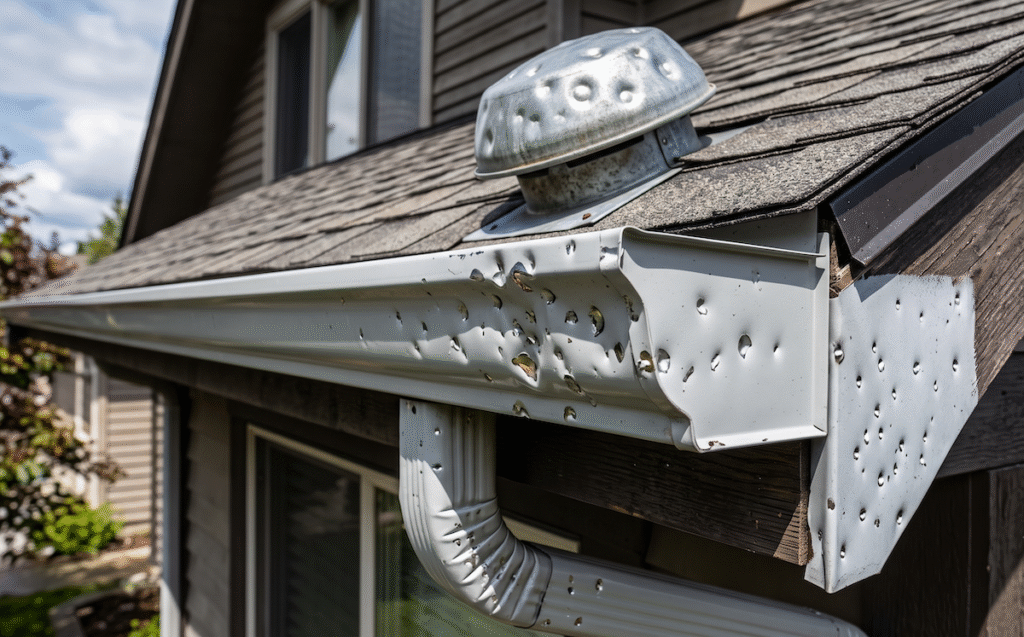
Hail is also hard on everything else up there. Metal roofs and metal components can dent, and the seals and flashing around vents, valleys, chimneys, and skylights can loosen or crack on impact, and those transition points are exactly where leaks tend to start. Vents, skylights, and eavestroughs often take visible hits that serve as a reliable clue the roof surface caught the same punishment.
Warning Signs You Can Actually Spot
You don’t need to climb a ladder to gather strong evidence that your roof took hail damage. In fact, you shouldn’t do a safe ground-level check. After a storm, walk the perimeter of your home and look for:
- Dented gutters, downspouts, and eavestroughs; soft metal shows impacts clearly and is one of the most reliable indicators
- Dings on metal vents, flashing, or your air conditioner’s fins.
- Granules collecting in gutters or pooled at the base of downspouts.
- Spatter marks or clean spots where hail knocked dirt off dusty surfaces like decks, railings, and window sills
- Dented siding, fascia, or window screens, which strongly suggest the roof took hits too
- Missing shingle sections or visible bruises you can see from an upper-storey window.
Here’s a useful rule of thumb: if you’re finding hail damage on the ground-level surfaces around your home, it’s safe to assume your roof, which sits fully exposed at the highest point of the house, caught at least as much of the storm.
Why You Shouldn’t Wait to Repair Hail Damage
When there’s no active leak, it’s tempting to shrug off hail damage and move on. That decision almost always costs more in the end. Every bruised or exposed shingle now ages faster than the ones around it, and our winters are ruthless about finding weakness. Water works into the cracks hail left behind, freezes, expands, and pries them wider with every freeze-thaw cycle. A roof that could have been restored with a targeted repair right after a storm can deteriorate into a full replacement within a couple of seasons.
There’s a second, more practical reason to act quickly. Most home insurance policies have time limits for reporting storm damage, and the longer you wait, the harder it becomes to prove the damage came from a specific event rather than general wear. Getting a professional inspection soon after a hailstorm gives you clear, dated documentation while the cause is obvious and all of your options are still on the table.
Repair or Replace After Hail?
Not every hailstorm means a new roof, and a trustworthy roofer will tell you so. When the damage is localized, and your roof is otherwise sound and reasonably young, targeted repairs to the affected shingles and flashing accessories are often all that’s needed to restore full protection. The picture changes when hail has bruised or stripped shingles across a large portion of the roof, or when your roof was already approaching the end of its lifespan. In those cases, replacement is usually the smarter long-term investment, because patching a roof that’s failing on multiple fronts delays the inevitable. The only way to know which situation you’re in is a proper inspection.
How a Professional Hail Inspection Works
A trained roofer looks for the subtle evidence most homeowners can’t see: soft spots that give slightly underfoot, displaced granules, cracked sealant, bruised shingle mats, and compromised flashing at the roof’s vulnerable transitions. We document everything thoroughly with photos, explain what we’ve found in plain language rather than jargon, and provide a clear written estimate. That documentation does double duty: it guides the repair and gives you solid, credible evidence if you decide to file an insurance claim.
Get Your Roof Checked by Scherger Roofing
At Scherger Roofing, we’re a family-owned, licensed, and insured local team that knows exactly what Alberta hail does to a roof, because we repair the aftermath every storm season. If a storm has rolled through Fort Saskatchewan, don’t wait for a stained ceiling or a dripping attic to tell you there was a problem all along.
Book your free hail damage inspection today. Call (780) 394-3404 or request a free estimate online. We proudly serve homeowners across Fort Saskatchewan, Edmonton, Sherwood Park, and Beaumont with 24-hour emergency repairs available for an additional fee for when a storm hits hard and you need help fast.
Your roof, our commitment.
FAQs
Q: Does Fort Saskatchewan really get enough hail to damage roofs?
A: Yes. Fort Saskatchewan sits in central Alberta’s hail-prone corridor and sees hail most summers. Even small, wind-driven hail can bruise shingles and strip protective granules, so damage is common even after storms that don’t seem severe at the time.
Q: How can I tell if my roof has hail damage?
A: From the ground, look for dented gutters, downspouts, and vents, granules collecting at downspout bases, and spatter or clean spots on decks and railings. If ground-level surfaces around your home show hail marks, your fully exposed roof almost certainly took hits too.
Q: Should I repair hail damage right away or wait?
A: Don’t wait. Bruised or exposed shingles age faster and let Alberta’s freeze-thaw winter work in, turning a small repair into a full replacement within a season or two. Most insurance policies also have deadlines for reporting storm damage, so acting promptly protects your options.
Q: Does hail damage always mean a full roof replacement?
A: No. If the damage is localized and your roof is otherwise sound, targeted repairs are often enough. Replacement makes sense when hail has damaged shingles across a large area, or your roof was already near the end of its life. A free inspection from Scherger Roofing will tell you which applies.